Memories of Carnaval
My relationship with Carnaval SF started in 1979, when Adela Chu and Marcus Gordon organized a group of dancers and musicians to parade around Precita Park. Adela asked me to create a poster for the first Carnaval. It ended up being a 6-color, 200-copy run and it was only my third attempt at screenprinting. I silkscreened it at KSW’s new storefront in North Beach after we were evicted from the I-Hotel. The poster was large and I had trouble pulling the squeegee. The light streaming in from the window made it hard to control the flow of the ink.
I asked Adela for assistance so she sent me a small group of performers who played music and sang to give me encouragement. One helper took each poster from the table and hung it on a makeshift clothesline with clothespins. After one color was printed on all 200 copies, I’d wash the ink off and prepared the next stencil for the next color. After much hard work, the piece was finally finished and we all danced with joy. The posters ended up in community storefront windows, our main mode of advertisement in those days.
After that first poster, I was hooked. I went on to create the poster for the second Carnaval in 1980 and then the third in 1981. After creating these three posters for Carnaval, I was not asked again until Roberto Hernandez commissioned me in 1987 and 1988. I was silkscreening at Mission Grafica then and could thankfully use the machine, which made it a lot easier to create large multiple prints. We also printed offset posters so the event was more widely publicized.
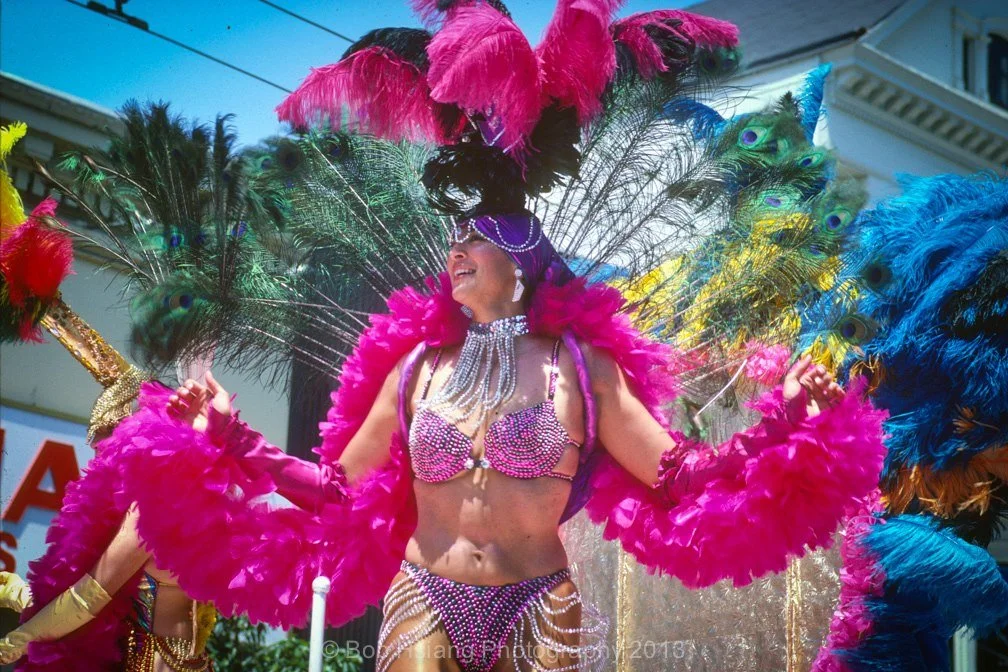
Besides making posters, I also participated in the parade in different ways through the years. I’ve been to many Carnavals, but here are some of the highlights that my memory can recall: I joined about 800 people to dance in that first parade. Adela taught us some simple samba steps; musicians played their infectious melodies, and we exuberantly pranced around Precita Park.
You don’t really get a sense of what goes into making the Carnaval parade happen until you participate in one. There are many rehearsals and sessions of costume-making and float decorating. On the day of, someone has to go and get the truck early in the morning and then line up at 7am at the designated spot along with dozens of other trucks. It’s very cold and you have to wait for a few hours until it is your turn to go.
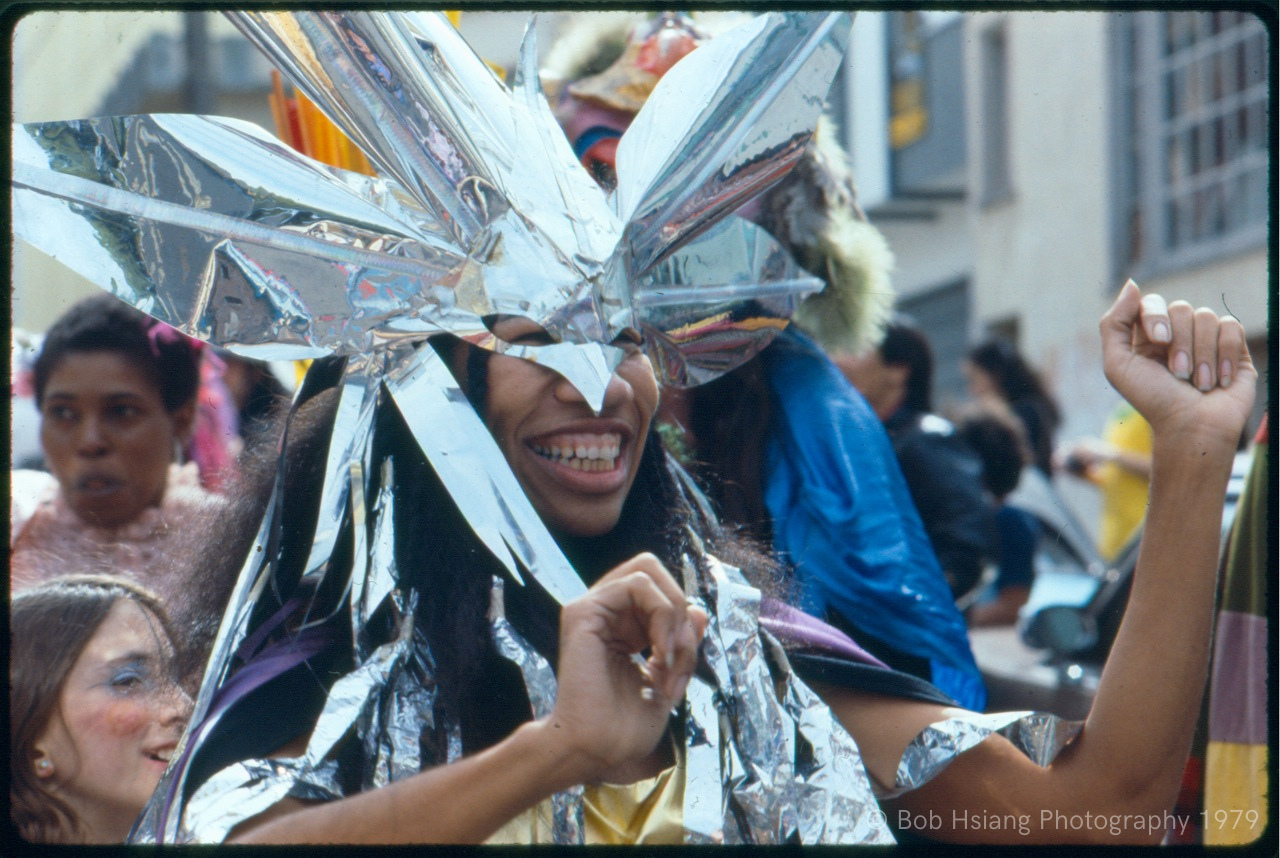
My husband Bob Hsiang was one of the early group of Carnaval photographers, along with Lou Dematteis, Simo Neri, and several others. They formed a tight bond that has lasted to this day. For a number of years, they photographed every Carnaval, and Bob has a huge collection of memorable shots from the first parade onward. Two of them – one of Adela and one of a dancer – are shown here.
In 1981, the only year the parade was taken from the Mission to Civic Center, I danced on the street with Adela Chu. She was in a costume and beaming her radiant smile. I wore a mask I had made from the silkscreen poster I created that featured the life-sized replica of her face. We were like twins when we danced together although she is taller than me. We attracted a lot of attention wherever we went. Adela moved to Hawaii but she often came back to San Francisco with her husband Kim Duffett to participate in Carnaval.
Another time I was part of the comparsa organized by Robert Kikuchi-Yngojo of Eth- Noh-Tec. He gave me a fierce-looking Indonesian mask to wear that covered my whole head. I danced on the street while the band played kulintang music on the float. I loved being behind the mask. No one recognized me and I could dance with total abandon. Because my mask was wild and demon-like, I would run up to the crowd and watch them recoil in mock horror or cheer me on. It was empowering. Dancing on concrete for 20 blocks was tiring but I had enough energy to join the post-parade festivities on Harrison Street.
To celebrate a banner anniversary (perhaps the 25th), I was invited to be on a float of the original participants of Carnaval. I loved being able to sit for a change and watch the crowd’s reactions. Unfortunately, I sat right next to the percussion instruments and my ears were ringing well after the parade had ended. Still, it was nice to be honored and to unite with some of the early members of Carnaval.
We took our daughter Nicole to Carnaval several times, rain or shine, when she was growing up but there was a time when she also participated in Carnaval, along with Adela and Kim’s daughter Hoku. Both were in grade school. They were in a special little kids comparsa that Adela organized and they rehearsed, made costumes, and danced in the parade.
When Carnaval turned 35, Ani Rivera, director of the Galeria de la Raza, commissioned me to create a mandala to pay tribute to this treasured festival. I created a 6-ft mandala on the floor of the gallery, with photos of the first Carnaval and the most recent one. I went to the Dollar Store to get beads and feathers to decorate the mandala. For the last row, I recruited community members to create little artworks to celebrate the vibrancy of the Mission. Due to that project, Bob and I earned two spots in the grandstand. We sat with the judges and the dancers gave a little performance in front of us. We had access to a bathroom and to snacks and Bob could walk out into the street to get a good shot of the dancers and floats.
Other years, when I didn’t have a seat on the grandstand, I’d stake out a spot and sit on a folding stool for the long wait between floats. Sometimes Adela and Kim would fly in from Hawaii and I’d hang out with them on Harrison Street after the parade. During my dancing years, I’d dance to whatever group was playing on the multiple stages. Some years we were busy to go to the parade and could only watch on TV. A few times I was out of town and sadly missed my favorite SF festival. In 2025, both Nicole and her 5- year-old daughter Opal went to Carnaval. We sat in the grandstand and Opal loved the whole parade. It was great to have our three generations of Carnaval enthusiasts together. I hope my granddaughter will someday get to participate in it, along with my little grandson. She loves to dance and he loves to play music.
Carnaval SF is the greatest expression of diversity, unity, and joy that is the very heart of this city. Thank you, Adela Chu and Marcus Gordon, for your vision and passion to bring the spirit of Carnaval from Brazil to San Francisco. Thank you, Ani Rivera and other leaders, for your persistence in keeping it vibrant. Most of all, thank you, Roberto Hernandez, for your tireless ongoing commitment to Carnaval and for giving it a permanent home in the Mission through your non-profit organization, Cultura y Arte Nativa De Las Americas (CANA). Casa de Carnaval is located at 683 Florida Street and offers cooking classes, dance studios, a recording studio, plus rehearsal and performance space. May Carnaval continue to thrive!